Traditional tools sample data to manage costs. Including customer IDs in your metrics makes your bill explode. So you aggregate and lose the signal. A modern data lake using Apache Iceberg stores every event for every customer at a fraction of the cost, enabling per-customer analysis legacy tools cannot afford.
How Is Observability Different in 2026?
Observability is no longer about watching servers. In 2026, AI agents monitor customer outcomes autonomously, investigating problems before anyone files a ticket. The question has shifted from 'Is my infrastructure healthy?' to 'Are my customers having a good day?'
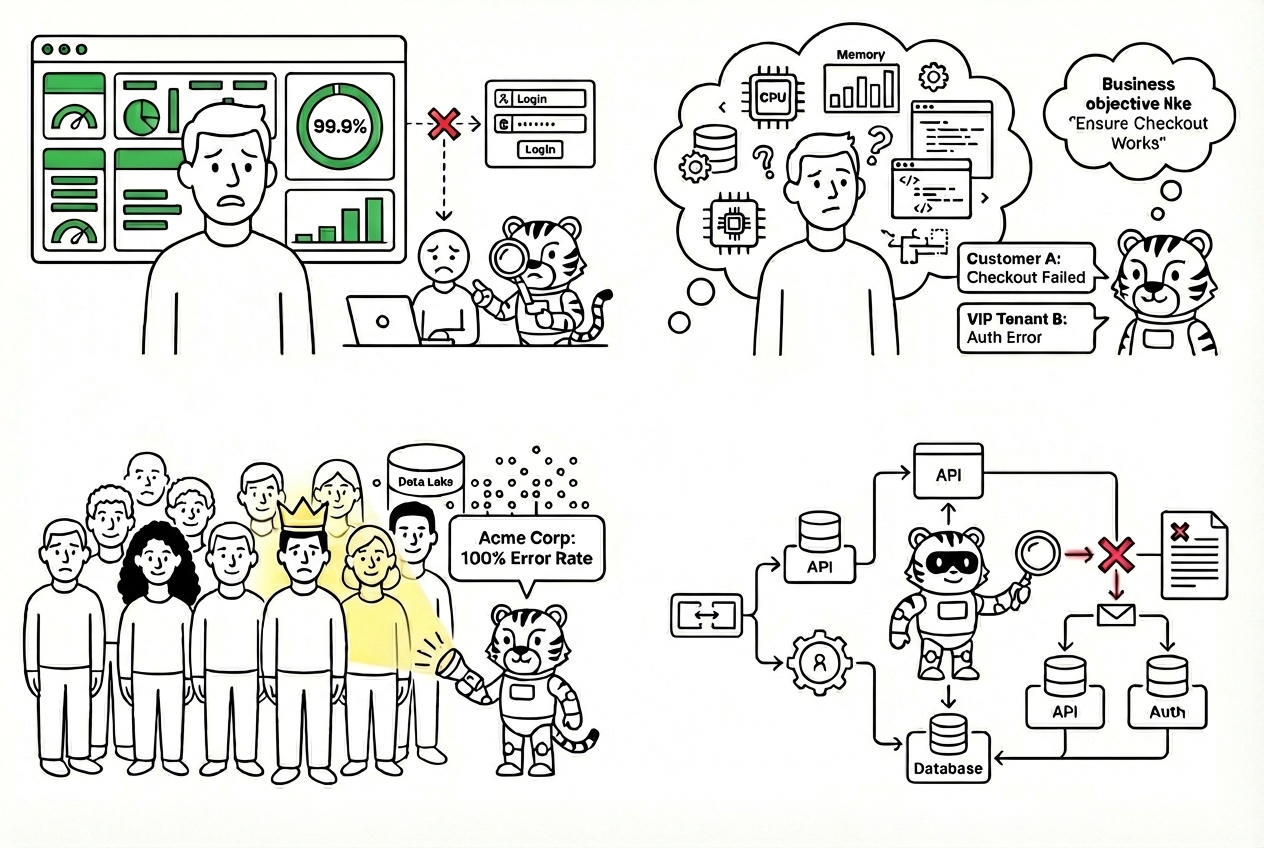
What Changed: From Server Metrics to Customer Outcomes
Dashboards stay green while your biggest customer churns.
Traditional tools optimize for medians and aggregates. Your P99 latency looks fine. Your global error rate is within SLA. But your most important customer just called your CEO because they cannot log in. That is the failure of classical observability and it is why 2026 demands a different approach.
Dimension
Legacy (Pre-2026)
Modern (2026)
Primary focus
Server uptime
Customer outcomes
Data strategy
Sampled, aggregated
Unsampled, high-cardinality
Alerting logic
Static thresholds
Semantic objectives
Investigation
Manual dashboard hunting
Autonomous AI agents
Cost model
Volume-based penalty
Lakehouse on open standards
Five Forces Driving the Change
The industry is moving faster than most teams realize.
According to a LogicMonitor survey of VP+ IT decision-makers, 96% expect observability spending to hold steady or grow, while 84% are consolidating tools into unified platforms. Only 4% of organizations have fully operationalized AI in IT operations, yet 62% are actively piloting it.
96%
of IT leaders expect observability spend to hold or grow (LogicMonitor, 2026)84%
of organizations pursuing tool consolidation (LogicMonitor, 2026)4%
have fully operationalized AI in IT ops (LogicMonitor, 2026)What Agentic Observability Actually Looks Like
From 'alert fired' to 'problem solved' without waking anyone.
The biggest trend in 2026 observability is agentic AI according to IBM. Agents scale resources, reroute traffic, roll back deployments, and restart services. They act on parameters set by automated decision engines that weigh urgency based on business impact, not just threshold breaches.
Per-customer baselines
Agents learn what 'normal' looks like for each customer, catching deviations invisible to global averages.
Autonomous investigation
Instead of paging humans at 3am, agents correlate logs, traces, and deployments to draft root-cause reports.
Semantic objectives
Define success in plain language: 'Ensure login works for enterprise customers.' Agents handle the SQL.
Release verification
Agents ride shotgun on every deploy, checking for regressions across customer segments and regions.
Key Questions About Observability in 2026
Why do traditional monitoring tools fail at high-cardinality data?
How does AI-driven root cause analysis work in practice?
When an outcome is at risk, an AI agent reads the full unsampled log stream, correlates errors with recent deployments, and drafts a root cause report. Firetiger agents detect a customer's misconfigured OAuth client, identify the deployment that caused the issue, and propose a fix before anyone is paged.
What is outcome-focused engineering and why does it matter now?
Outcome-focused engineering flips the script. Instead of monitoring inputs like servers, pods, and bandwidth, it monitors outputs like customer success, revenue integrity, and workflow completion. You define success in natural language, such as 'Ensure Microsoft's login latency is healthy,' and agents continuously verify that reality matches intent.
Is observability consolidation worth the migration risk?
According to a 2026 LogicMonitor survey, 67% of IT leaders plan to switch platforms within 1-2 years. OpenTelemetry makes migration easier than ever. The real cost is staying put: engineers waste critical minutes jumping between platforms during incidents, connecting dots manually while every minute costs revenue.
Ready to See Outcome-Focused Observability?
Move from dashboards to customer outcomes
Firetiger's AI agents monitor every customer, every release, every region. See how it works for your stack.